Issue 4: Routines & Disruptions
A quarterly conversation about process and craft with authors Anna-Marie McLemore, Emily X.R. Pan, Anica Mrose Rissi, Sara Ryan, and Nova Ren Suma.
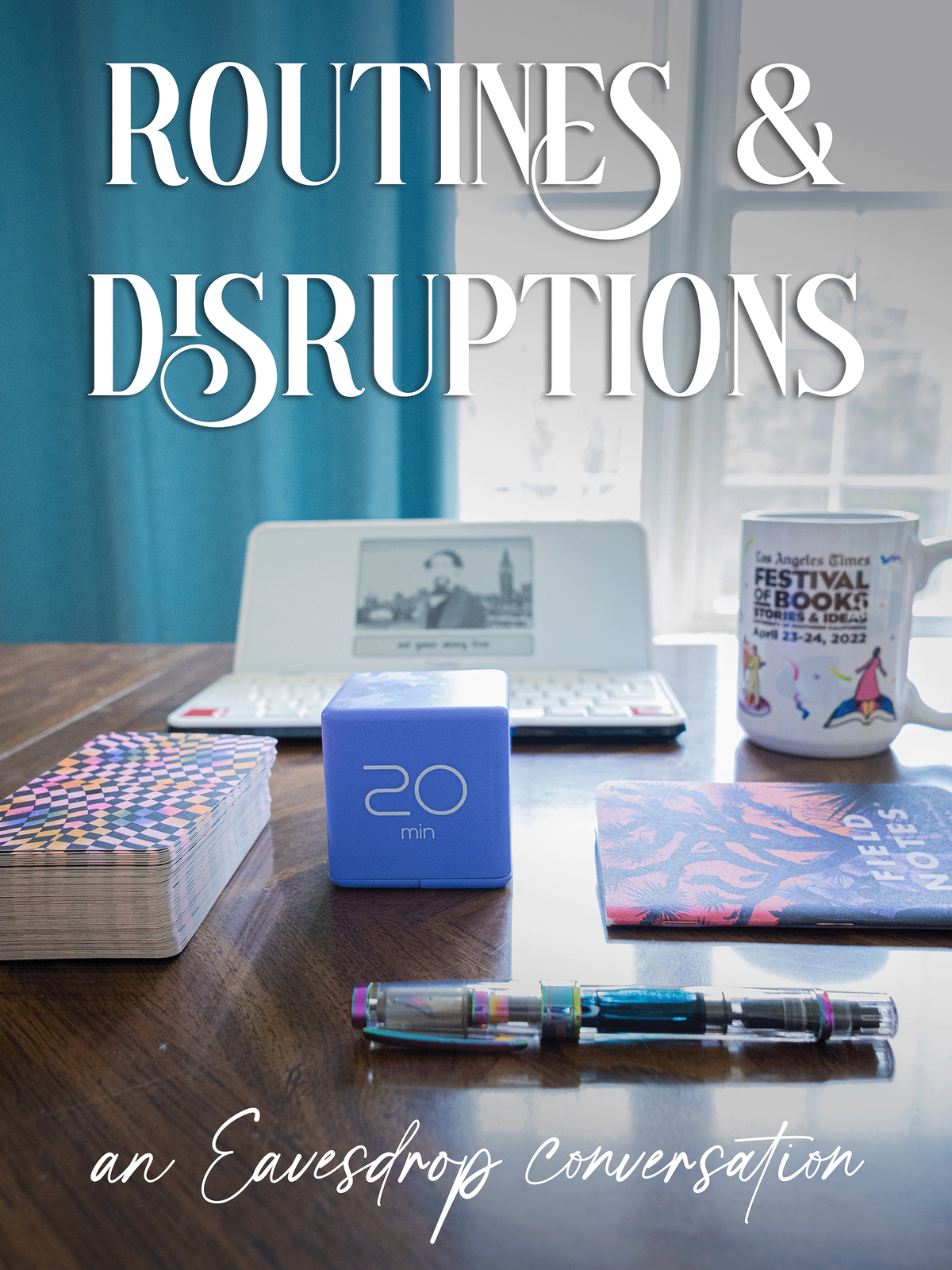
Welcome back to The Eavesdrop, with Anna-Marie McLemore, Emily X.R. Pan, Anica Mrose Rissi, Sara Ryan, and Nova Ren Suma. In this issue, we’re discussing routines and disruptions: the ebbs and flows of our writing lives, our best- and worst-laid plans, and how we’re making space for creativity—and adjusting to the unexpected—in this particular moment.
Grab a floatie and jump in. We’re glad you’re here.
And don’t miss this season’s extras—including a giveaway for subscribers—at the end.
Anica: I approach summertime the way many approach a new year: full of aspirations and optimism about new habits and routines, and all the wonderful things they’ll help me create. It’s the season of fireflies! Magic is in the air.
How serendipitous that at the start of this summer, I’m at the start of a new project. I’ve been gathering snippets of the idea for months, and I’m ready to sit down and draft but not sure how to structure my time. Shifting from the wandering, brainstorming, and collecting phase of writing (which overlapped with the promoting-the-book-that-came-out-in-April phase of authoring) means a significant change in routine. I need to figure out how first drafting will fit into my life as it currently stands and what the project itself needs to thrive. From project to project and season to season, my routines are rarely the same. Is that true for you too? What are your creative routines in this moment?
Sara: I’ve thought a lot about routines in the past year, because at the end of last June I stepped away from my full-time day job. While I was working full time, my schedule constraints meant that, paradoxically, it wasn’t hard to develop a writing routine. I knew I wouldn’t be able to write much (if at all) during my work week, so my routine was to write on the weekend.
But I also tried to set myself up to easily take advantage of small interludes of writing time: I drafted Mountain Upside Down in a Google doc and would sometimes add to it on my phone during my breaks.
That part of my creative routine changed, in part because I’m trying to figure out how to break up with Google, and in part because the book I’m working on now is very research-intensive. So I’m drafting it in Scrivener, which is also where I have the majority of my research material & notes.
Friends cautioned me that not having a day job wouldn’t make me a faster writer. I hoped they wouldn’t be right, but they absolutely were. I only have so much writing energy—I can’t write 8 hours a day; some people can but I’m not one of them—and also, I’ve discovered that it can be harder to structure my writing time now that I (theoretically) have more of it!
That said, two things have helped me develop my current creative routines:
- Places. I have a designated writing space at home, and I also have some outside-the-house favorite places to write, where my brain kind of kicks into writing gear as soon as I’m there.
- People. I schedule regular writing dates with friends. I find it incredibly helpful to be around other folks engaged in similar work.
Emily: I also really work well with writing dates, and a huge reason for that is my ADHD. I thrive with body doubling. It’s very soothing for my brain to know that people around me are working. It actually serves me well even if other people aren’t writing—I just need the mirroring of people being focused to help me lock in. That means that when I’m trying to work while alone, it can be extra hard to sink in. But I do have a few ways to trick myself into it.
These days my favorite is to start by journaling about the project at hand. I do this longhand, in cursive, in a physical notebook, using a fountain pen that’s loaded up with a bright color ink. I give myself a lot of freewriting prompts, and I have a lot of conversations with myself on the page. I’ll ask things like, “Why am I struggling with this scene?” and then try to unpack it. Every notebook of mine is dedicated to a specific book I’m writing, and that’s about as organized as the journal gets. Within those pages, anything goes. Sometimes I’ll write whole chapters longhand, sometimes it’s lists and notes, sometimes it’s doodles and maps to help me envision spaces. But probably the bulk of the pages is made up of these freewriting entry points. I write longhand until I shake some important idea free, or until I’m itching to dig into a scene, and then I switch to the document.
That’s the most effective routine when I’m drafting. I’ve worked really hard to build a practice with minimal ritual and requirements, because back when I had a corporate job I had to squeeze my writing in during whatever cracks of time that I could find, and wherever I happened to be.
When I’m revising, the routine becomes much more obvious to me. I reread what I’ve written. I re-outline the whole book to get a bird’s-eye view of the story and its structure. I note the changes I want to make, scene by scene, in a fresh document that becomes the roadmap for the revision. I apply the changes, then lather, rinse, repeat. Some parts of this are slower, but the next step is always obvious to me. And I continue to do a lot of journaling during all this, because writing longhand was how I first began telling stories, and something about the physicality always calls me back into the right mindset.
A-M: With you on the notebooks, Em. I do a lot of writing by hand throughout a project, particularly at the inflection points—starting a new book, figuring out my approach to historical research, working things out for a big revision. A downside that I’ve turned into an upside is my handwriting. It’s way messier than I’d like, but that means there’s no option but for me to keep up with transcribing. If I wait more than a few days, I’ll have no idea what that scrawl in the middle of the page says.
Sara, places is a big one for me too. Getting outside is an essential part of my writing routine. Not always to write—some days I am going to be far too distracted by birds and trees and butterflies to write outside—but to help my brain reset before I start.
Set-shifting really helps my ADHD, and I think it helps a lot of us, ADHD or not. Sometimes set-shifting means a literal different location, but it doesn’t necessarily have to. I recently heard the always-profound Will Alexander say something along the lines of “if you write your novels at the same desk where you do your taxes, you’ve got a problem.” But the good news is that a space can also be transformed by what is or isn’t there. If I have my physical therapy diagrams covering my desk, that space is going to feel like a PT gym for that moment. Later, if I put all that away and bring out my notebook and sketchbook, my favorite pens, the research books, a rock that looks like a character’s favorite rock, then that space feels transformed. I’m suddenly somewhere else even though I’ve come back to the same place.
Nova: You’re looking at someone who is setting a new writing routine, as of this month and this solstice, gazing into the summer ahead. I’d overloaded myself by teaching two novel workshops this winter/spring, and my days were filled with student manuscripts and office hours and trying to be dynamic enough to get people to engage during class, etc. I simply wasn’t able to make much progress on my own creative work while this was happening, which I should have guessed. But both classes have ended, and now I have only one independent monthly workshop over the summer (with five incredible, dedicated writers!), so that’s a joy. Beyond that, all I need to do is turn in my syllabi for the fall and write my novel this summer.
That’s all, Nova? Just writing a novel? [Insert hysterical, knee-slapping laughter here.]
Anyway, here’s my routine for the next several steaming-hot weeks: Get up as early as I can muster, have quality time with the gorgeous and loving black cat who visits our backyard most mornings, do yoga, eat the same breakfast I eat every day, write a new entry in my novel journal, and go to my writing room and get words out for as many hours as I can. I’m first-drafting a novel, and I’m trying to give myself a daily word count. My manuscript is due in the fall and I’m feeling an extraordinary amount of anxious pressure to make that happen and make it good.
I used to live in Manhattan in a tiny shared apartment that I kept for sixteen years, so I had a routine of going out early to write at the Writers Room by myself, or with writer friends at Think Coffee on Mercer Street. But years ago, right before the pandemic, I moved to Philadelphia, and I lost my writing community, my writing space, and I no longer go on writing dates. Now I have my own room to write in, and this has changed my routine in some thrilling and not-so-great ways.
One good thing that changed: Reading aloud has become a part of my process. I could never do that when I lived in New York City, because I had no privacy.
The not-so-good: There is internet in my writing room and I sometimes have a hard time not looking at texts and emails when they come in, so it’s not the cocoon it should be. I’ve also become a bit of a hermit, and I worry about my isolation tendencies. I do miss what Sara and Emily were talking about: writing with or around other serious writers used to be especially motivating to me.
Anica: I tend to get self-conscious, distracted, and very little done when I write with other writers. I still say yes to writing dates because I love my writer friends, but my best work happens when they’re not around. For the first several Anna, Banana books, I woke up early and wrote for forty-five minutes before work, nestled on the couch with my dog and a teapot beside me and two El Ten Eleven albums on loop. Whenever I hear one of those songs, I’m instantly transported back to those days, that apartment, that creative challenge, and I feel only the pleasure, none of the pain of it, though I’m certain the pain was there. (I can no longer write with music on, by the way—how did that ever work for me?) I would start each session by revising what I’d messy drafted the morning before, and end it by messy drafting what I would fix the next day.
I wrote Nobody Knows But You during late afternoons at the library, using my walk there to shift into a writing mindset and my walk home to let my thoughts wander. Library closing time determined when my workday was finished, though I also set very low, attainable daily word count goals because I was working under deadline. During Covid lockdown, I drafted Wishing Season (on scrap paper and in Scrivener) and revised Girl Reflected in Knife (with pen on printouts) between 11pm until 4am, hours when there weren’t so many headlines to anxiously check and the darkness of night allowed me to sink into a creative mode that was difficult to access in daytime.
I’ll have to experiment to find what times of day will work best for this new book. I’ve done much of my pre-draft idea collecting and character eavesdropping while pulling up invasive plants or on morning runs, and I might try to stay in the habit of brainstorming during those times and jotting down the ideas after, but with the added steps of not only typing up the notes once I’ve scrawled them but also turning them into real scenes. On an ideal, empty writing day, it will be easy to find time for that. But my calendar is already loaded with interruptions, large and small. What kinds of disruptions are you anticipating in your summer, and how do you plan to sustain or adjust your routine in the midst of that?
A-M: Anica, your Anna, Banana routine sounds like a work of art. There’s something beautiful in a writing routine that’s that specific. There’s also something beautiful about how you’ve adjusted your routines in relation to what you’re working on, the hard things and the good things going on, where you are physically and in terms of brain space.
My writing routine tends to change and flow a lot depending on what’s going on, but I do have touchstones I come back to in the midst of disruptions. Thanks to two dear friends I’ve had a lot of writing dates with, a specific kind of tea and an MLB game will make me instantly ready to write. Connecting with the sensory details of a world—see aforementioned rock—brings me into a story.
And, of course, there’s cosplay.
I recently ran into an author friend who now regularly writes in period gowns, which is one of my favorite writing routine things I’ve ever heard. Talk about making a writing session an event. What impressed me even more is that she does this no matter what genre or time period she’s writing in. I’m not sure I could do that. When I’m cosplaying and writing, I think I’d be distracted if I was in period costume writing in a contemporary setting. If I’m dressing up to write, I’m probably going for something a character in my current work-in-progress might wear.
Anica: Oh my gosh, I love that. [Dons full-body tortoise costume plus wings to work on next picture book.]
Nova: Imagine me in a nice, pointy witch hat! I wonder if adding some of this playful joy to my writing practice would help me face some of the oncoming disruption that’s due to hit my doorstep in August. We recently got a letter from the city that there is a giant construction project coming to our block this year—they’re replacing the water main and the sewers, and the work could take six months to a year. I looked out of my beloved, usually so quiet writing room the other day to see the spraypainted marks on the sidewalk that show where the jackhammers will soon be digging. They are literally right under my window. I’m not going to be able to escape this, and I don’t know when it will start or how long it will last.
So, truly, what can a writer on deadline who gets migraines from loud noises do with this kind of physical disruption… short of finding somewhere else to live?
This is why I feel such an urgency to spend the summer getting out as many words as I can, before the construction starts. But I also know that, when it does start, I can’t use it as an excuse not to write. Whatever form the disruption may take—a new job, a new class, the doorbell interrupting me in the middle of a sentence, a literal jackhammer—I need a way to pull myself back in.
Sara: And disruptions are inevitable, right? I wonder if that’s part of what people are thinking about when they warn against having a hyper-specific set of Optimal Writing Conditions—the right space, the right pen, the right time of day, the right amount of time to write, etc.—because maybe you’re never going to have those Optimal Writing Conditions, or if you’re lucky enough to have them, you probably won’t be able to keep them. (Case in point: as I’m typing this now, in one of my favorite writing spots, there’s an interesting conversation going on that I’m having a hard time ignoring.) So I feel like maybe part of the trick is figuring out the things that help set you up for success, but then also thinking about how you can adapt when one or more of those things shifts. (Maybe there’s a library nearby that has bookable study rooms?)
Because in addition to all the external disruptions you mention above, Nova, sometimes the disruption call is coming from inside the house: a creative routine can go stale, and then you have to figure out what changes will make it more effective.
Nova: I appreciate this wisdom, Sara! Sometimes a disruption is necessary.
Anica: Yes! I consider this a key tool in my writing arsenal: knowing not only how to set and stick with a routine, but also how and when to break it. There are many days (often when I’m feeling stuck, overwhelmed, or like I just don’t wanna and possibly can’t write this manuscript) where getting the writing done means tricking myself into doing it, often through a change in routine that allows me to pretend I’m not trying to create anything good—like taking a clipboard, pen, and pup to the dog park and handwriting notes on what I would put in the scene if I were actually writing it, which clearly I’m not. See, I’m nowhere near my desk or favorite library chair, there’s nary a computer in sight, and I’m not even writing this in the tense or POV it would be in if it were a real scene, which it isn’t. Taking the pressure off the work by disrupting the routine can help turn it back into play, shake new ideas loose, and allow me to get something onto the page.
A-M: I love this idea of choosing certain disruptions, of having some ways we shake up our own creative snow globes in addition to all the things that unavoidably shake them up.
Emily: I agree, and I love the thought of us being in our own creative snow globes! I also think what Anica said about tricking myself into writing, pretending it’s just scraps and not necessarily anything good—that really resonates, and is an important mindset for me. I need to feel like I’m at play in order to enjoy the writing. I need to not be stressing about whether it’s “worthy” or not in order to feel like I’m at play.
I will often turn my story this way and that, angling it like a gemstone to catch the different flashes of light, trying to find some shiny and new and exciting way to approach it. When I feel hugely disrupted is probably when I do that the most. I look at what I’ve written and try to find a new, commitment-free entry point to make it feel fun again. Maybe that means giving myself permission to jump to a completely unrelated scene. Maybe it means making observations about a character from the perspective of an inanimate object.
And I’ll often do this by somehow changing my work environment. Switching from screen to longhand, as I mentioned before. But also maybe I’ll write in a different orientation—spiraling around a page, for example, to force my brain to think differently. Sometimes I’ll switch up the ink color I’ve loaded up in my fountain pen, or switch pens altogether. Sometimes changing from cursive to print is what shakes me free. I experiment a lot to create a sense of whimsy and play.
Sara: I love all this—and the emphasis on creating a sense of play feels especially apt for summer!
Disrupt
Nova: It’s time for some, dare I say, meaningful disruption! Let’s use the concept to our advantage. Come to this prompt with a work-in-progress—a novel or short story, perhaps.
First, here’s how my dictionary of choice (Merriam-Webster, the collegiate edition) defines the term:
dis·rupt verb
1a : to break apart : rupture
<Three periods of faulting disrupted the rocks. — University of Arizona Record>b : to throw into disorder
2a : to interrupt the normal course or unity of
<… disrupted a bridge game by permanently hiding up the ace of spades … — F. Scott Fitzgerald>
b business : to cause upheaval in (an industry, market, etc.)
With the idea of trying to disrupt in mind, go to a scene you’re writing that feels like it’s not entirely working as is. Maybe you lost steam halfway through, or maybe it fizzles out or doesn’t seem to have a purpose. Now find a place in that scene to do something you never planned.
Disrupt your scene by breaking something apart, by throwing the events into sudden disorder, or by causing an upheaval.
Afterward, ask yourself: Did the disruption change your stagnant scene and offer you something worthy to follow?
Maybe a disruption is needed every once in a while, to shake things up and make life worth living… and to create a story worth telling.
Anica: Talk of routines and disruptions calls to mind this Leslie Jamison quote, which I love so much, I take any excuse to share it. It’s from an interview she gave in 2018, while promoting The Recovering: Intoxication and Its Aftermath.
“I used to believe that the best writing had to emerge from a life that had been carefully sculpted to produce the perfect conditions for creativity: long stretches of uninterrupted time, days cleared of logistics and obligations, dentist appointments and school lunches and cardboard boxes waiting to be unpacked. But eventually I learned that no beautiful writing comes from an impossibly perfect world; it all comes from this one: cluttered, obligated, distracted. After I came to accept that beauty comes from the imperfect mess of living, rather than the impossible ideal of an unencumbered life, it asked me to stop seeing life and writing as antagonists, locked in combat, and to start seeing the ways that even the logistics and obligations of life might ultimately feed into the compost heap of creativity, and certainly that the obligated, beholden life is the only one from which we work—that so much beauty has come from it.”
Right now Sara can't stop listening to the soundtrack from the recent Merrily We Roll Along revival. This legendary-flop-turned-multiple-Tony-Award-winning-hit has so much to say about art and commerce and friendship and betrayal and compromise and success and failure! It doesn’t work as writing music since the lyrics are unignorable, but it’s so worth listening to! And watching, for that matter—a filmed version of the show is available from some streaming services.
Each quarter Emily will offer a Tarot reading to capture the energy we might carry with us through the season and into the next stage of our projects.
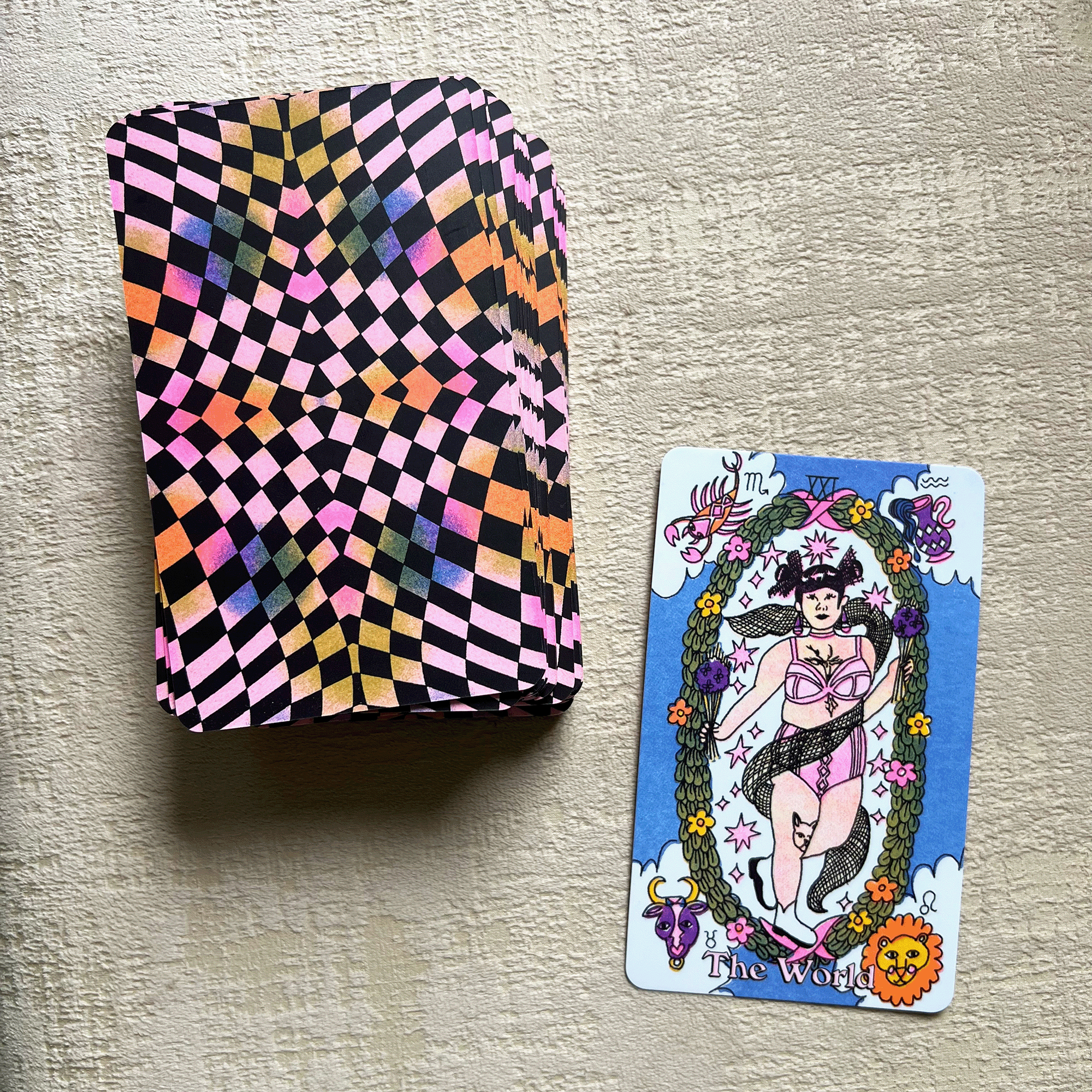
It's Pride Month, so obviously I had to use the Queer Tarot! I ended up pulling The World, which is the final Major Arcana card, and one that very much emphasizes completion.
For anyone who's just finished a full draft or project, this is calling for you to celebrate and reflect. What lessons did this cycle teach you? What obstacles did you overcome? Take a good full look at what you were able to accomplish. It might feel daunting to be in between projects, or even to choose what to start working on next, but The World can be a reminder of what you're capable of.
For those who are still working to reach a point of completion, this card is cheering you on. You can do it! Look back on all that you have done so far and celebrate it, and remember that as long as you keep moving forward, however slowly, you are making progress. It's all part of the cycle. You are on a journey, and The World is within reach.
For me personally, I feel like the card is representing both of the above stages. Just a few weeks ago I turned in Draft 10.4 of my book to my editor, and that iteration was a huge lift. I also definitely didn't celebrate it enough, because I'm not good at celebrating myself. Now I've gotten notes back from my editor, and I'm trying to wrap my mind around this next revision cycle, and I'm feeling totally intimidated by it. These reminders from The World card really resonate.
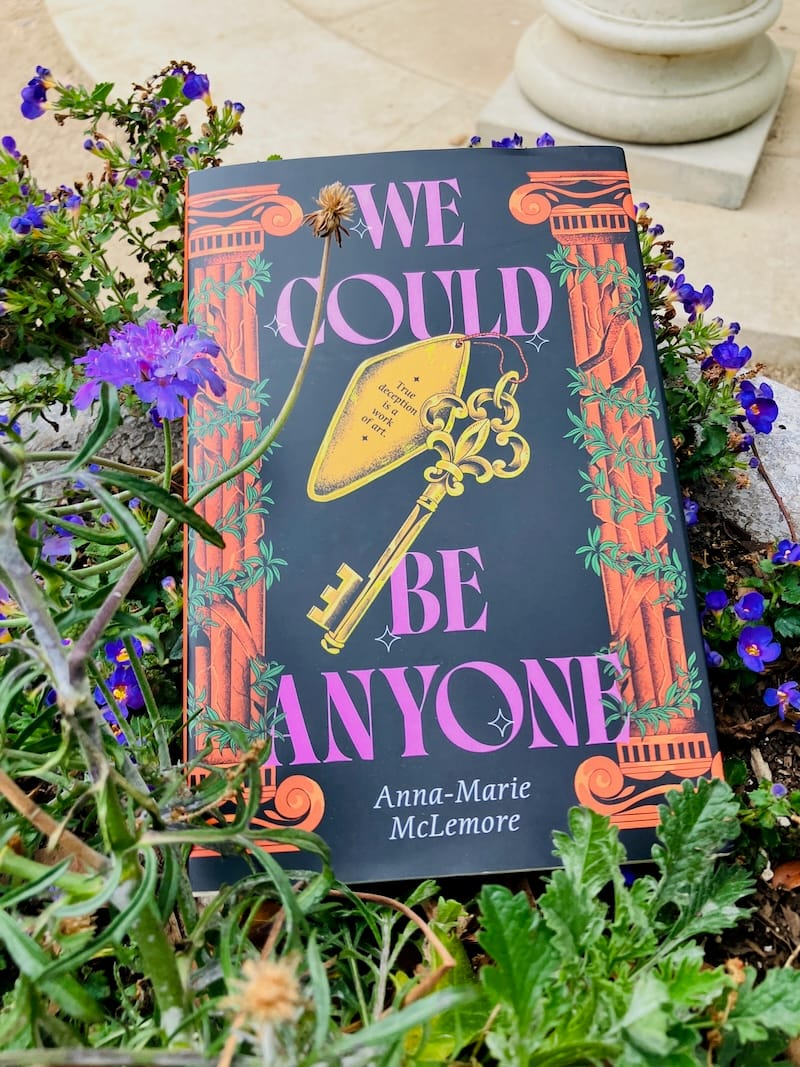
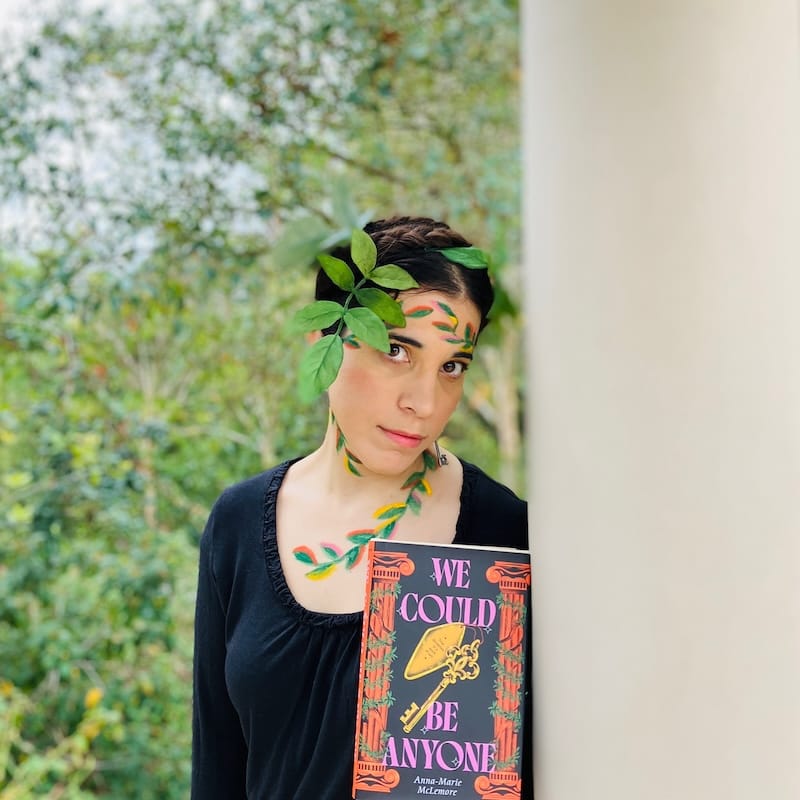
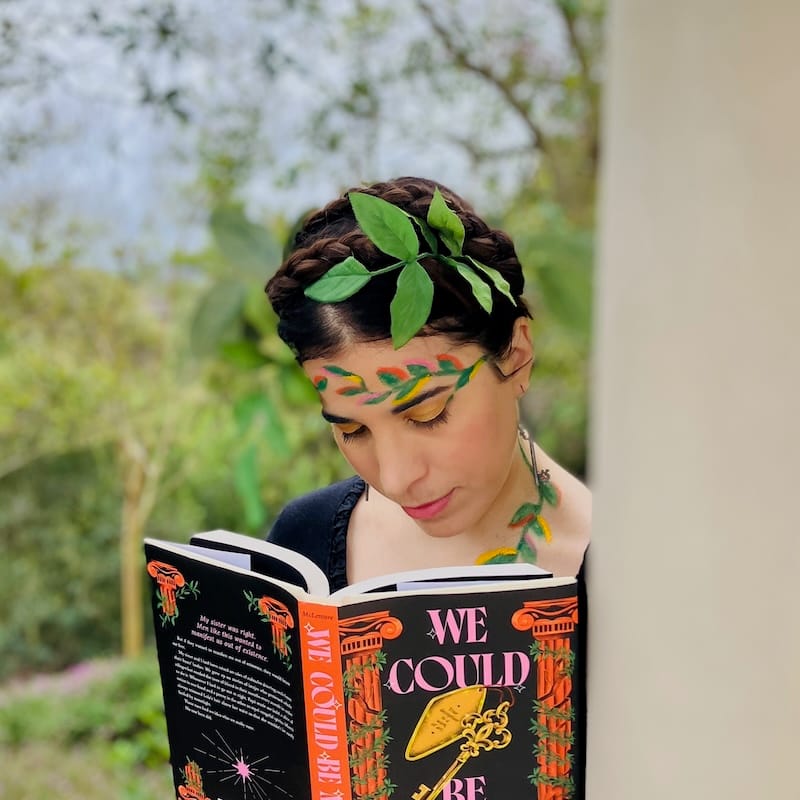
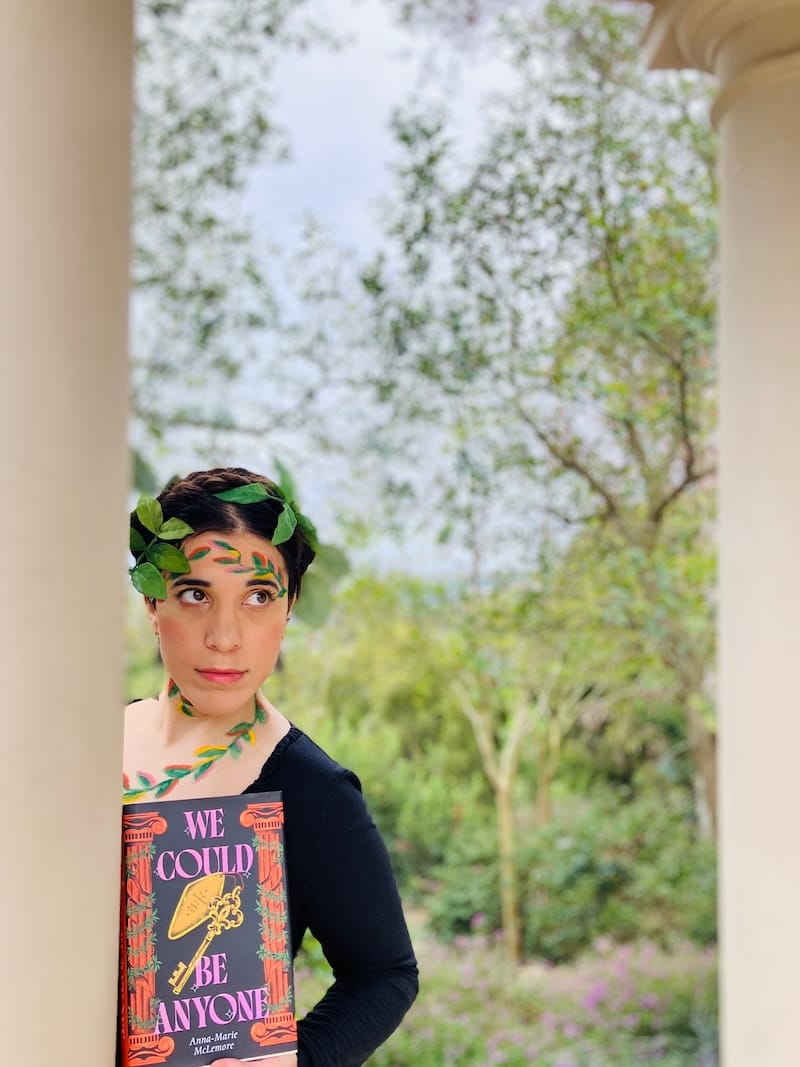
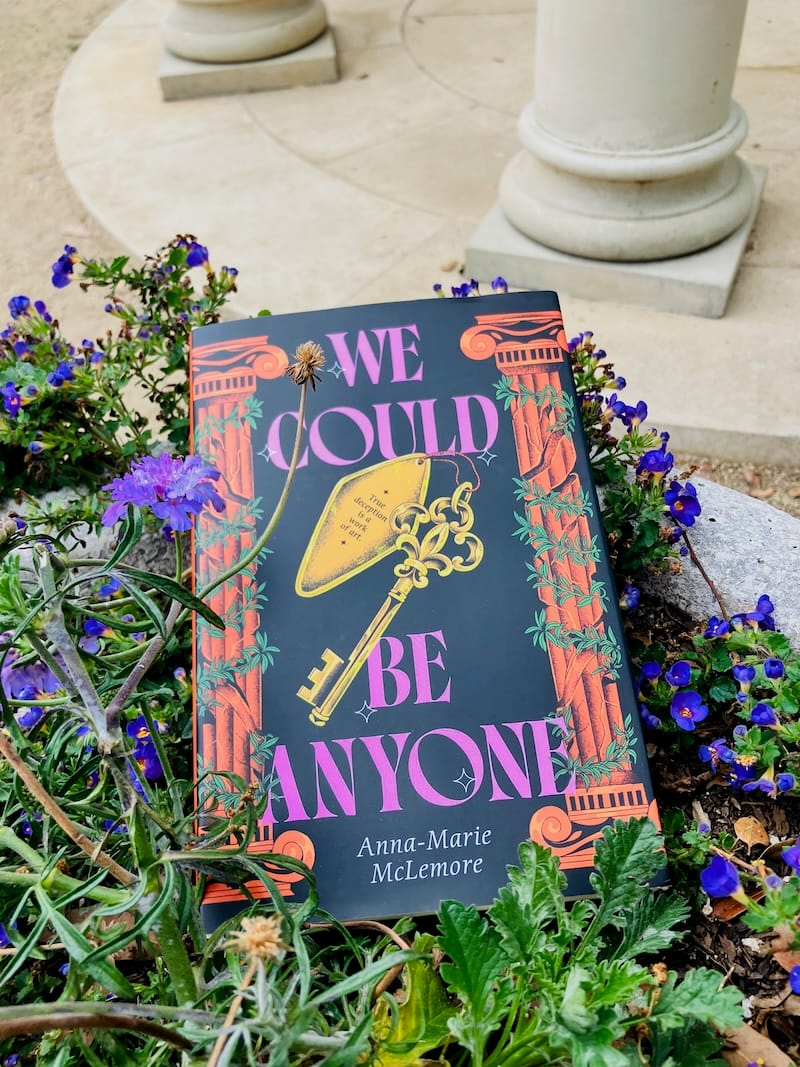
Bienvenides a Cosplay Corner, where A-M dresses up as a book character or book cover! New on shelves is my latest, We Could Be Anyone, part ghost story, part tale of a brother-sister con-artist team, part gaying up Golden Age Hollywood.
For this one, I did a little cover cosplay, a little character cosplay, covering myself in leaves and finding some columns to flit between just like Lola.
Someone’s always trying to turn girls into something that will put them in their place.
Sisters who get in the way of the gods’ plans.
Daughters who don’t do what their fathers want.
Girls who fall in love when they’re not supposed to and who don’t fall in love when someone wants them to.
They get turned into trees, or flowers, or birds, and that’s supposed to be the end of the story.
But I’m not letting it be the end of mine.
A-M says mil gracias to everyone who came out to launch week events for We Could Be Anyone—mucha gratitud y muchos abrazos to you all! You helped give this book an amazing release week.
Sara is joining Ari Koontz for a Youth Pride Celebration at the Literary Arts bookstore in Portland, Oregon on June 30, 6 pm.
Anica and Zachariah OHora’s “very funny” (PW, starred review) picture book The Teacher’s Pet comes out in paperback with a fun new cover on July 7. It’s “a guaranteed chuckle” (USA Today) that’s “perfect for classroom read-alouds” (SLJ). If you (or a kid or teacher you know) like “wonderful and whimsical” (BookPage) picture books filled with “brilliant illustrations and silly hijinks” (BookRiot) “bound to make any child giggle” (Deseret News), pick up a copy and enjoy Anica and Zach’s “over-the-top sensibilities that mesh fantastically” (NYTimes).
Anica's electro-country band, Owen Lake and the Tragic Loves, is releasing a new album, Bury Deep My Heart, on July 24. Anica cowrote all the songs, plays fiddle throughout the album, and sings background vocals on two of the tracks. One song also features Emily on mandolin! Bury Deep My Heart is up for preorder on Bandcamp now (vinyl, cd, and digital) and will be available July 24 on Apple Music, YouTube, Spotify, or any of the major online music services. The band will play record release shows in Brooklyn, NY (July 23), Princeton, NJ (July 25), and Nashville, TN (August 18 & 19). Come dance and cry along!
Nova will be teaching her online speculative novel workshop again this fall with Stanford Continuing Studies. This is a 10-week asynchronous writing workshop with optional live weekly Zooms that meet on Thursdays. Writers working in all speculative genres are welcome, as are those writing for adult, YA, or crossover audiences. Registration opens August 17, and the course starts September 24. Join Nova’s workshops mailing list or email her at nova@novaren.com to get notified in August right before registration opens.
The winner of a signed hardcover of We Could Be Anyone will be randomly selected at the end of August, so subscribe now to be entered to win!