Issue 5: Research
A quarterly conversation about process and craft with authors Anna-Marie McLemore, Emily X.R. Pan, Anica Mrose Rissi, Sara Ryan, and Nova Ren Suma.
Welcome back to The Eavesdrop, with Anna-Marie McLemore, Emily X.R. Pan, Anica Mrose Rissi, Sara Ryan, and Nova Ren Suma. In this issue, we’re discussing research: the rabbit holes down which we fall (sometimes deliberately, sometimes not), what we find there and how we use it, and signs it might be time to climb out and return to the page.
Roll up to the card catalog and join us. We’re glad you’re here.
And don’t miss this season’s extras, including a research-related writing prompt, process prompt, Tarot reading, and more!
Sara: I’m working on the most research-intensive book I’ve written so far, a historical YA set in 1930s New York City. Because of this, I’m thinking a lot about the role of research in the writing process, and how regardless of what we’re writing, there’s always a need for research, a need to, as Merriam-Webster states in their definition: “study or investigate carefully.” Research can make invented places, like secondary-world fantasy settings, feel real. Research can deepen and add nuance to the characters we create. Research can increase our confidence and spark new ideas.
But exactly what that research, that study and careful investigation, looks like varies so much from project to project, not to mention at different stages within a project. I’m so curious about how you all approach research; first, how do you think about what you need to research, and then how do you go about doing that research?
A-M: I love research, and I tend to do pretty deep research for any genre I write, contemporary included (I talked with an expert on cliff swallows for The Mirror Season). But Sara, you’re getting me thinking specifically about historical. With historical fiction, there’s usually a reason that the story I want to tell belongs in a particular time and place, so that’s where my research often starts.
For Dark and Deepest Red, I was writing about the Strasbourg dancing plague, one of those things that sounds like an unsettling fairy tale but actually happened, dozens and then hundreds of people literally dancing themselves to death. I read everything I could get my hands on about the Strasbourg dancing plague (and some things I couldn’t get my hands on but that some very generous scholars gave me access to). And as I was doing that, I got an idea of what else I needed to research to know the landscape of this time and place. That starting point showed me what I needed to research next.
With Self-Made Boys: A Great Gatsby Remix, it was a very different starting point because good luck reading everything you can get your hands on about 1920s New York. It was wonderful because there was so much, but daunting because there was so much. So I started with why I’d wanted to write this story in the first place: I wanted to show Gatsby and Nick in love on the page. I researched the queer and trans community they might’ve found in New York at the time. I researched how a trans guy would’ve gone about trying to pass. And here’s where the process began to mirror D&DR, because from there, I got a sense of what I needed to research next. Basically I started with the queer and went from there.
Emily: When I first started writing The Astonishing Color of After, the very original idea for it was actually adult historical fiction, spanning the first forty years of a woman’s life starting in 1927 in Taiwan. It was inspired by my maternal grandmother. I quickly found myself overwhelmed by the research—there was both too little that could be found about the remote mountain village she grew up in, and too much to consider about the rest of Taiwan and the time period. I realized that I was feeling stuck as a result; I had to pivot and write instead from the perspective of her granddaughter getting to learn the grandmother’s story for the first time. After that my tactic shifted: I decided I would mainly research to fill in gaps and make details more accurate. So I would first write a scene and then question every element of it and go in search of answers. I did a lot of interviewing of family members, and even made a trip to Taiwan so that I could accurately capture the places I was writing about.
I think research is such an important way of exploring the contours of what we’re writing and sinking deeper into the world. I once spent close to seven hours looking up obscure shipping vessels that would have operated around certain small East Asian islands in the 1980s, just to write one sentence that I deleted maybe three drafts later. But I didn’t consider that a waste of time—it was me swimming across the currents of my story, examining different corners and crevices and hunting for treasure.
Even for my current project, which is a secondary world fantasy, I’ve found research to be important. My characters end up at sea, and while I can of course invent some magical solutions for what the story needs, I want to be sure that the experience aboard the ship feels true to life. I’ve done a ton of research just for those little details of how certain things are named, how the decks would be mapped out, how sailors would interact, terms they would use, stuff like that. This has included reading books, watching documentaries, asking many many questions of people who have worked on tall ships and cruise ships, and of course scouring the internet.
Now I’ve also got a new historical novel brewing, and for that I’ve actually needed to change tactics and do much more research up front in order to set the stage and figure out the worldbuilding. Ironically I’m encountering a lot of the same obstacles I hit when I was trying to figure out that historical version of Astonishing, but I think I’ve grown as an artist because it no longer scares me. This work feels just as important as figuring out the voice and style and plot arc. There’s this giant stack of books in my office that I’m slowly working my way through, and eventually I’m hoping to get in touch with a few historians. I’m excavating the very bones of the project by doing this research.
Anica: Aside from the ongoing writerly practice of paying exquisite attention to whatever captures my interest, following it with curiosity, and adding those scraps to the creative compost heap (i.e. collecting sparks to fuel whatever’s next), I don’t typically dive into research before I start drafting. But once a draft is underway, I look things up constantly as I go. Sometimes that research is about finding specific answers or facts, but just as often, it’s a way to discover the questions that will lead me deeper into the story and guide my exploration and understanding of it.
I nodded vigorously, A-M, when you said, “I started with why I’d wanted to write this story in the first place.” That, for me, is so often what research is really about, even when it appears to be about checking what birdcalls one might hear on a late June morning in downeast Maine or what the average 7-year-old can be expected to know about the number zero. The details I collect may or may not end up on the page, but they are part of immersing myself in the story and swimming in those currents Emily mentioned. I never do side writing, but I do a ton of side research, and I’ve come to understand it as a pivotal part of my process.
Nova: Thinking about where my process started to take shape—my relationship to research and my initial wariness about using it in the right way—I go back to when I studied journalism in college. I started as a work-study reporter my very first quarter and then became editor of our campus paper by the end. For a brief moment, that’s what I thought I’d do with my life: become a journalist and write about things that were “real” with solid research and interviewed sources. But the truth is, my heart wasn’t in it and my head couldn’t stay grounded. My imagination kept getting away from me, my propensity to exaggerate and insinuate and play, and soon enough I embraced the realization that I’d probably be a better fiction writer and focus only on invention, not fact. The problem was, fiction isn’t wholly your own invention, is it? We know that even when we create a story world and a character, it’s never out of thin air. All of what you’ve all shared cements that so beautifully. At least for me, I began to see that taking what was “real” and twisting it was my favorite thing about writing fiction, and with that in mind I needed to make sure the ground was solid enough to let the fantastical elements take flight.
It took me some time to understand how to best allow research into my fiction-writing process. Now I see research as a way to deepen and enliven my stories. Surprising sparks come from it. This sounds similar to what Anica just spoke to: My story and characters often come first and research comes when the story asks for it. When I have questions, when I can’t see the road or the people or the next corner, research can help me figure it out. I don’t use everything I’ve researched in the story either, but certain elements open tiny doorways for me and sometimes the story changes because of what I’ve found. A steam whistle blowing to warn the last remaining villagers that the dam was finished and the floodwaters would come during the building of the Ashokan Reservoir inspired a tiny haunting detail in my novel Imaginary Girls. An actual boardinghouse called Katharine House on W. 13th Street in New York City and the death of a young woman who stayed there led me to Catherine House and the opening scene of my novel A Room Away from the Wolves. The dehumanizing details of a teenager visiting a parent incarcerated at a maximum-security prison started off as fact-checking what kind of ID my character would need in my novel Wake the Wild Creatures and then served as direct inspiration for a significant sequence when my narrator visits her incarcerated mother.
Even the smallest piece of research can be magical. Like right now, as I write a novel set in a place I knew as a child, I find myself stopping to check aerial maps and unearth old photographs. The other day I spent an hour walking the bridge I crossed as an unaccompanied child, not literally but through the magic of street-view, simply to write a single sentence just like Emily did for those obscure shipping vessels in their novel. Was my imagined walk necessary? Probably not. Will I delete the sentence later like Emily did? Maybe. But oh my, it feels like it helped.
What are some research rabbit holes you’ve all found yourselves falling into, magical or otherwise?
Sara: Honestly I feel like at this point I’ve established permanent residence in a research rabbit warren, and I scuttle around digging tunnels between all the individual rabbit holes. But I can talk about the initial inspiration for the book and a few of the places it’s led me: on June 6, 2023, Nora Dolliver and Mia Bruner of the New York Public Library published “Struggle in the Stacks! Researching NYPL’s Labor History.” That’s where I learned about a publication that Communist library workers produced in the 1930s, called The Class Mark.
The title plays on the term “classmark,” the first letter of a book’s call number. The publication’s logo is designed to look like the title request slip that readers filled out, since the books were kept in closed stacks—aka, not open to the public for browsing.
“The Class Mark” also evokes social class, and class struggle; fitting for library staff who wanted better working conditions. Some of the staff with the worst working conditions were the pages whose job it was to retrieve requested books.
Pages, I learned from reading The Class Mark, walked between five and eight miles during a shift. Pages got tuberculosis because of poor ventilation. Pages were not able to get raises or advance to other positions. Pages were all teenagers. The Class Mark had a section just for them: “THE RED PAGE: A Page for Pages.”
When I read that, I immediately knew I wanted to write from the point of view of one of those pages, and that said page would be queer. So, A-M, my first few rabbit holes related to NYC queer communities were probably similar to yours with Self-Made Boys, although my timeframe is a bit later. (George Chauncey’s Gay New York: Gender, Urban Culture, and the Making of the Gay Male World 1890-1940 has been a goldmine.) Emily, hearing about your research on obscure shipping vessels made me remember spending several hours squinting at a microfilmed 1934 telephone directory, transcribing the names of businesses that my protagonist would’ve seen on his way to work. Nova, your description of how what started as fact-checking became an inspiration resonates, too: I was looking in Art News for reviews of an exhibition I wanted to include and saw a writeup of a snow sculpture competition for kids; now, my protagonist is gonna see at least one of those sculptures. And Anica, what you said about paying exquisite attention to whatever catches your interest and following it with curiosity is really what’s been driving my entire process with this book, maybe to a fault!
Which leads me to ask: how do you decide when to stop researching? At what point does it become procrastiresearch?
A-M: I have to watch out for procrastiresearch more when I’m deep in drafting a story than at the beginning. If I hit a point I’m having trouble getting my brain around, research can certainly help spark things into place, but the line between “this is helping” and “this is an interesting distraction” can occasionally get a little thin. That doesn’t tend to be as much of a problem at the beginning, because the more I get my bearings in the world I’m writing, the more excited I tend to be to get started. It’s more when I don’t want to face something in the story, whether it’s a problem I need to solve or a scene that’s hard to write, that I need to watch out for extensive research adventures into what floral arrangements were in vogue at the time. Maybe not the best example though, because that particular procrastiresearch ended up sparking a plot point…
Anica: I think that’s a perfect example of how tangential research adventures and other “interesting distractions” are actually important parts of the writing process. We invest our time, attention, and selves in our work, and part of what makes an A-M novel an A-M novel is that your attention was drawn down that rabbit hole and, within it, you found an actual, useable rabbit.
In terms of when to stop: Although I do not want to be writing the same book forever, efficiency is never my goal. The goals are thinking, exploring, discovering, and creating. So I don’t berate myself when I spend a whole day looking up the sleep patterns of bees for a sentence that doesn’t matter in a scene that may well be deleted. I’m a writer who cares about minutiae, and we need to follow our own fascinations in order to make good art.
Often when I’m pulled down a rabbit hole or lured toward a beehive, it’s because the draft itself needs me to dawdle. Those side explorations are a way of keeping my attention within the world of the story, while allowing the actual draft a bit of a break from the pressure of my immediate focus. Focusing on bees or other tangential distractions gives the rest of my brain time and space to work on the parts of the project that are not yet ready for direct eye contact, but which need to be finessed before I can plunge ahead. Sometimes lingering near but not in a problem is the best way to find my way through it. Once the knots and snarls around the problem have loosened, the draft will call me back.
Nova: I don’t know if this is procrastiresearch or what—or maybe some of my signature self-doubt creeping in—but sometimes I am simply overwhelmed with all I don’t know and I freeze beneath all the unknowing… I’ll be poised at the moment of fully committing, wanting to be immersed in imagining and exploring and letting the characters lead the way, but then the weight of the unknown sits on my chest and asks me that cruel question: Is this really a book you can write right now? Do you know enough yet? Don’t you need more time?
Sara: So maybe the point when the research rabbithole has transmogrified into a roadblock is the time to shift your approach? Because, as completely enamored as I am with research, I’ve also ended up abandoning projects when I ended up in the frozen state you describe, Nova, feeling like I’d never know or understand enough. I wonder if, then, the strategy is, as A-M mentioned earlier, to step away from the roadblock, lean back into the overall ‘why’ of the project, and trust yourself that you’ll figure out what you need to know for the book when you need to know it.
Nova makes great use of prompts in her writing practice. She collects prompts and invents them too. This quarter, she'll share one with you...
For this research-related prompt, let’s stay off the internet and in the tangible, AI-free world. Let’s also leave it up to fate, the randomness of the universe, and perhaps a little divination.
Step 1: Find a research book you’ve purchased or borrowed from the library. Ideally this is a book that you haven’t yet read.
For example, I went to my research and inspiration shelf and found a book I've collected for a future novel. The book is called Italian Folk Magic by Mary-Grace Fahrun.
Step 2: Hold the book you chose in your lap. Talk to it and tell it what you’re looking for. (I’m just kidding. I think?)
Anyway, take the book and quickly flip through the pages as if you were fanning a deck of cards.
Stop on a random page, wherever your fingers lead you, and open the book to the page the universe has chosen for you.
Step 3: Write down the very first word or phrase or passage your eyes land on, whatever it may be.
Do this three times.
In my example, I went ahead and did this just now and here are the three things my eyes landed on from the book I chose: 1) the phrase “charge the amulet” on p. 105; 2) “star anise” on p. 9; and 3) the passage “Some people believe that you should never photograph a sleeping baby. To do so will result in the baby dying in their sleep” on p. 79. Now I’m inspired. Eek!
Free-write on the three things you found. See where your imagination leads you, and then consider what more research you might do to dig deeper into these new rabbit holes!
If you find anything interesting you want to share, you can leave a comment on our Instagram post that we’ll be sharing from @thisistheeavesdrop!
This writing prompt was inspired by my friend Camille DeAngelis, who once shared a divinatory prompt that captured my imagination in an online course she taught about creativity. I don’t think the course is active now so I can’t find it to point you to, but thank you, Camille! I also heard about Alexander Chee’s bibliomancy exercise [paywalled] after writing this prompt and now must go try it! It’s clear that allowing the unseen and the subconscious to guide your creative practice can lead to illuminating discoveries—even when it comes time to do the work of research.
Sara: Broadly speaking, I think there are two basic types of writing research: one is macro-level, where you’re kind of zooming out, looking for an overview that will increase your understanding of something big that plays an integral role in your work in progress as a whole: perhaps an era, a subculture, an ecosystem, or an economy. The other type, micro-level, is a search for information with the goal of enhancing a particular scene. Often, micro-level research starts with a hyperspecific question, and then the answer to that question spurs additional questions that further enhance and propel the narrative. An example from my work in progress: I have a scene where my protagonist needs to borrow an iron. My initial research question was: what did an electric iron look like in 1934? Once I’d answered that, I moved on to wondering about the kind of person who’d have an electric iron in my setting. I won’t share all the steps, but answering the electric-iron question eventually led me to a new character, a naval electrician’s mate who also has experience as a film projectionist.
So here’s the prompt, in two parts: First, come up with a micro-level research question. Second, list out some possible ways you might answer that question beyond typing keywords into a search engine or YouTube or Reddit. Maybe you know someone who’s a subject matter expert, and you can ask them—with proper compensation, of course! Maybe there’s a museum or archive with materials relevant to your topic. Maybe your next step is to consult a librarian. To be clear, I’m not recommending that you avoid online research altogether! But when you use a variety of research strategies, you’re more likely to come away with genuinely surprising and valuable information and insights. Good luck!
Anica: I’m currently forty-five hours into the fifty-four hour audiobook of Robert A. Caro’s exhaustively researched Master of the Senate and kind of never want it to end. But the first Caro book I ever read is Working, his book on (as the hardcover tagline promises) Researching, Interviewing, Writing. I highly recommend it—and the documentary Turn Every Page: The Adventures of Robert Caro and Robert Gottlieb, about Caro’s relationship with his editor—to anyone interested in writing, research, and process. Here’s a quote from Working’s introduction.
“It’s the research that takes the time—the research and whatever it is in myself that makes the research take so long, so very much longer than I had planned. Whatever it is that makes me do research the way I do, it’s not something I’m proud of, and it’s not something for which I can take the credit—or the blame. It just seems to be a part of me. Looking back on my life I can see that it’s not really something I have had much choice about; in fact, that it was not something about which, really, I had any choice at all.”
Each quarter Emily offers a Tarot reading to capture the energy we might carry with us through the season and into the next stage of our projects.
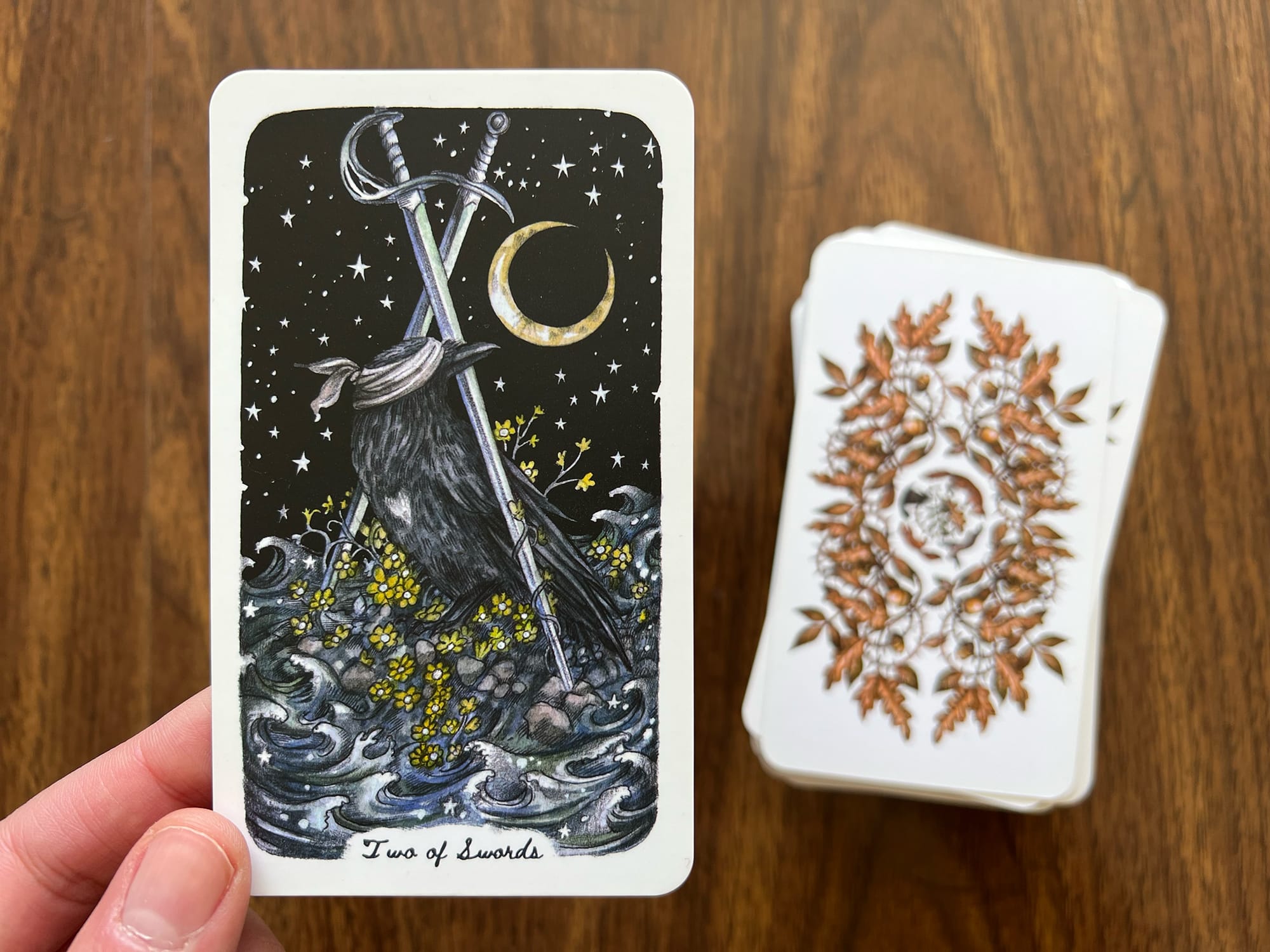
For this issue's Tarot pull, I used the Oak, Ash & Thorn deck for its cozy autumnal vibes. I started by drawing the Two of Swords. In this depiction a bird is blindfolded where it is perched below two crossed swords. In more traditional iconography this is usually a blindfolded woman holding the two swords with her arms crossed in front of her chest.
The Two of Swords indicates that you're caught at a crossroads, stuck between two directions. Curious, I drew two more cards for a sense of what the different directions may be.
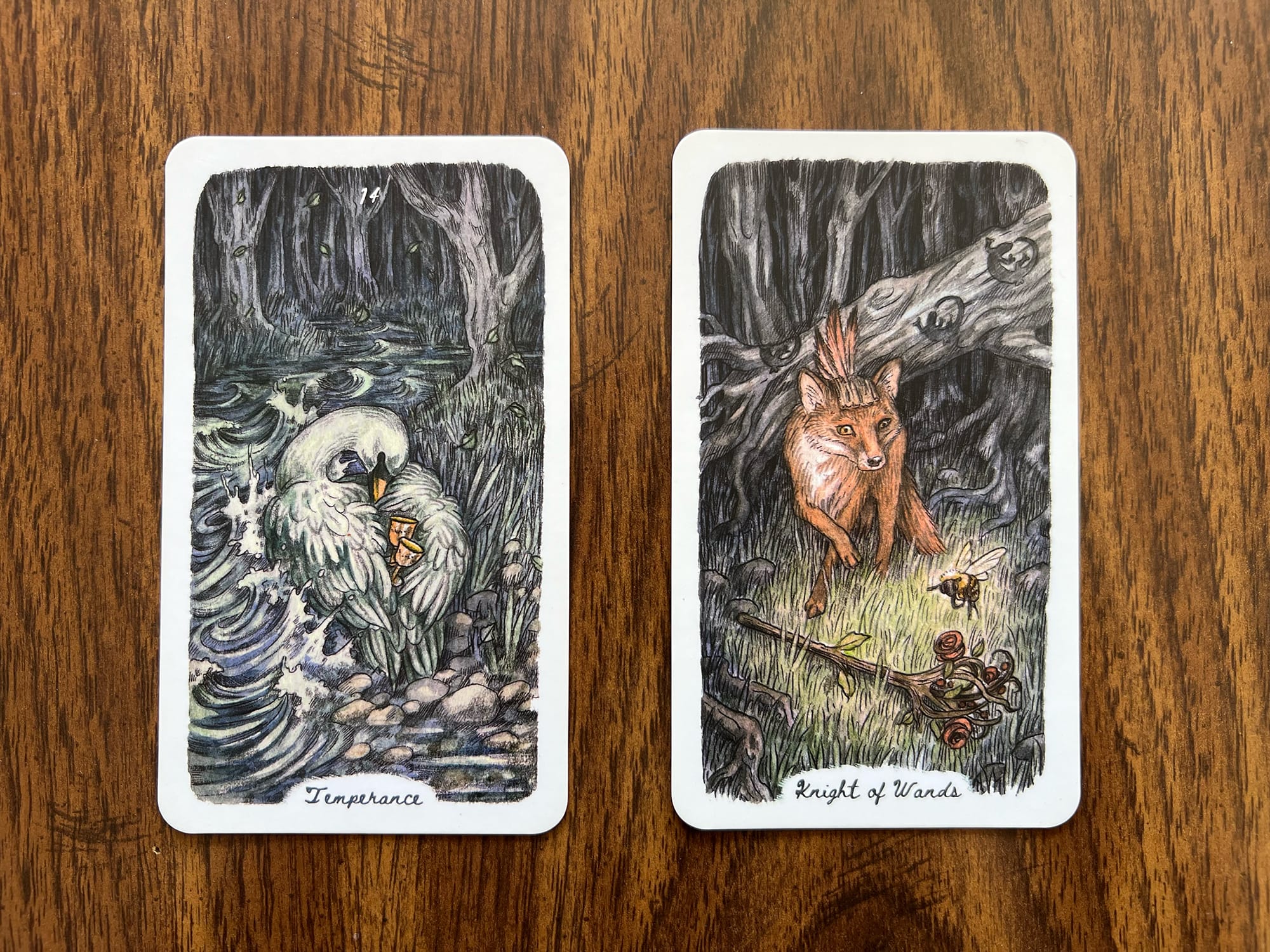
We ended up with Temperance, which is a card about finding stability and moderation, and the Knight of Wands, which is about charging forward confidently and Doing The Thing. Energetically I can see how these might be two very different directions, especially if you are trying to decide which project to focus on, or if you are trying to determine what strategies or processes to use in tackling your work.
It's useful to know that the Two of Swords is typically a reminder to find the balance. In my own practice I see this as referring to how I’m vacillating between processes at the moment. I am torn between: A) wanting to do a slow and plodding edit that operates primarily at the line level at the same time as I'm further developing the interiority and emotionality, at the same time as I solve the major puzzles left in the book. And B) wanting to rush on ahead with fixing the big plot things that I can already see the answers to, letting myself take the dessert first method to get a sense of satisfaction. So far I've been leaning very Knight of Wandsy in this, and I have been charging ahead too much. And it's actually leaving more holes behind me. So I'm realizing now I have to pull back from that a little and slow down.
You might use this reading as a moment of interrogation for yourself. Ask: What are you trying to decide between? Which is the slower, more patient, more stable route? And which is the exciting, high energy route? What are the pros and cons of each? And then: Is there a way to have some of both?
Bienvenidos a Cosplay Corner, where A-M dresses up as a book character or book cover!
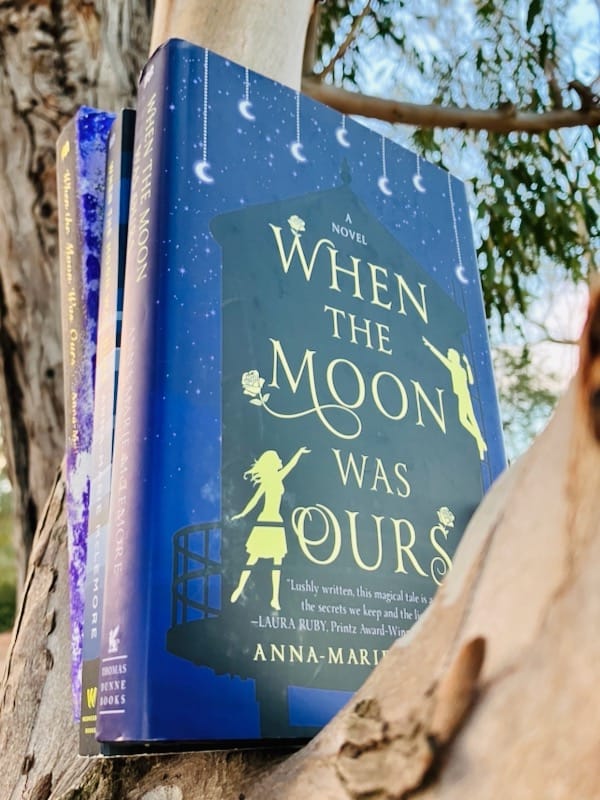
On October 4, it’ll be ten years since the release of my book When the Moon Was Ours.
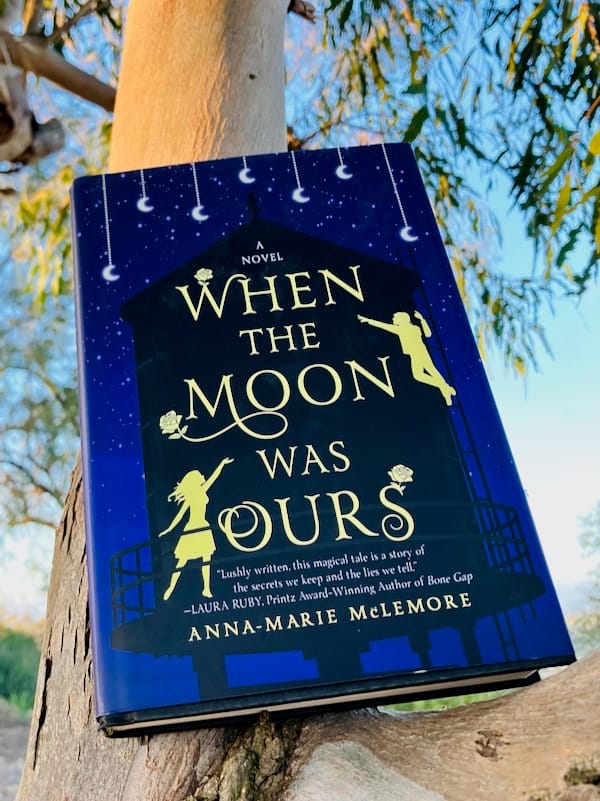
Moon was my first queer book and my first trans book. My whole heart went into this story even more than I realized at the time.
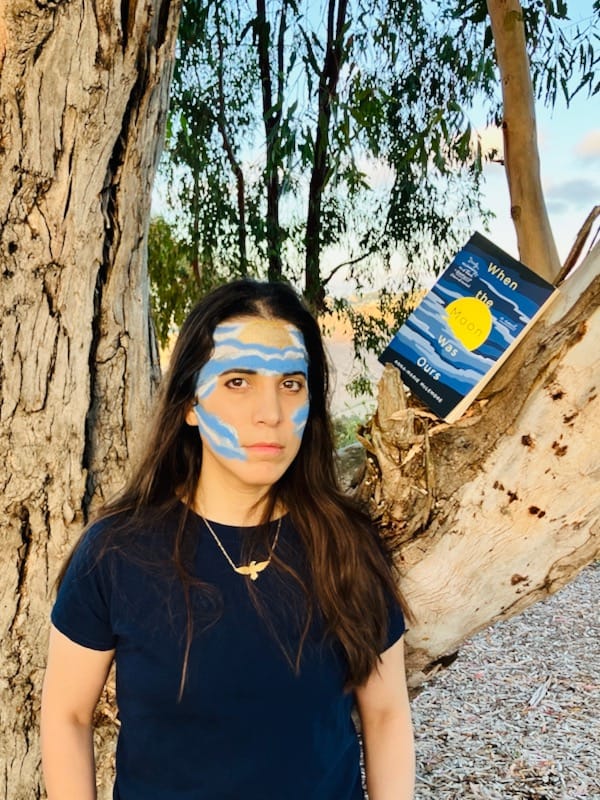
A few years after Moon’s release, I realized I was nonbinary, that I was a boy as much as I was a girl.
Sometimes our hearts know who we are before the rest of us does.
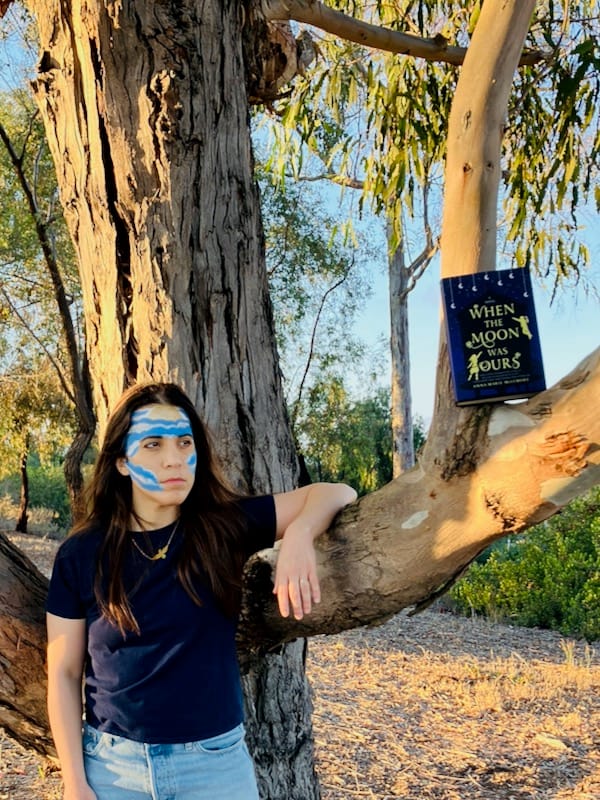
Mil gracias to everyone who’s embraced this story of a boy who paints the moon, y abrazos fuertes to all of us figuring out our own hearts.
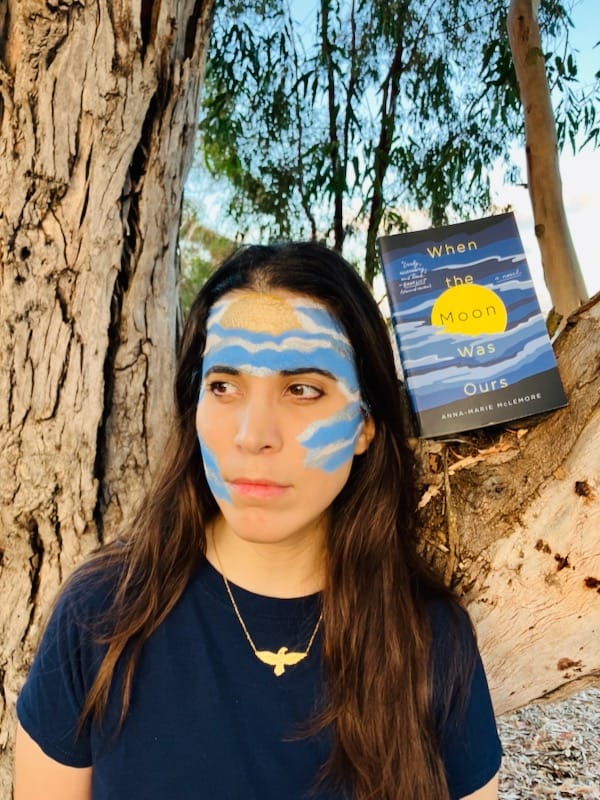
To the boys who get called girls,
the girls who get called boys,
and those who live outside these words.
To those called names,
and those searching for names of their own.
To those who live on the edges,
and in the spaces in between.
I wish for you every light in the sky.
Nova is living a personal dream come true because the French language edition of her latest novel, Wake the Wild Creatures, will be coming out in France from Gallmeister in October. Isn’t the French cover moody and filled with wondrous light? Pardon her rudimentary French, but elle est trop excitée!
A-M is in a tree somewhere working on their secret next book (more on that soon). In October, they’ll be in Spokane, WA for The Joint Conference of Librarians of Color (JCLC).
Anica looks forward to meeting readers and signing books at the Morristown Festival of Books’ KidFest in Morristown, NJ on October 10 and the Warwick Children’s Book Festival in Warwick, NY on October 11. She and author Amy Jo Burns host the third Writers on Writing conversation at Labyrinth Books in Princeton, NJ on November 12. And Anica will visit several elementary and middle schools this fall to share her love of story through interactive presentations and writing workshops. If you would like her to come for an author visit at your school or library, please be in touch!
Emily will be at this year’s NCTE Annual Convention on November 20 for the Books Save Lives panel at 9:30am in Room 104-AB.
Sara has no news, except that they’re enmeshed in…research!